
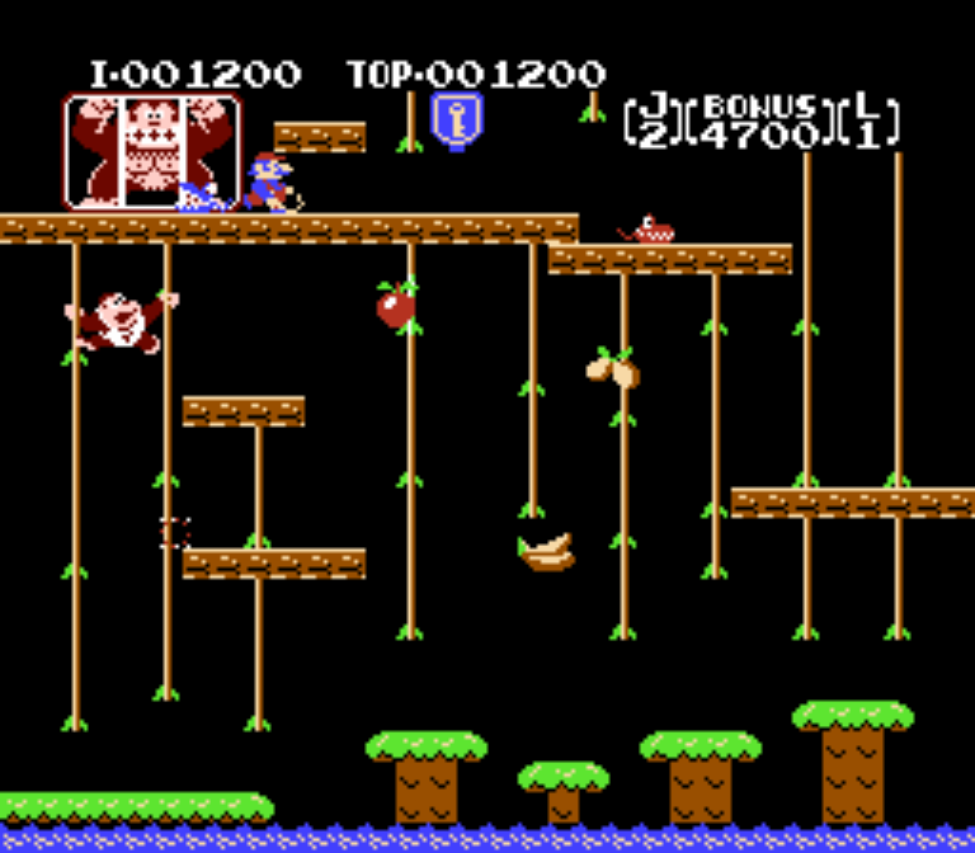
After the massive success of Donkey Kong, Nintendo followed up with a bold and unexpected sequel: Donkey Kong Jr. Released in 1982, just one year after the original, this game flipped the script in a way few sequels dared—it turned the hero into the villain and introduced a brand-new protagonist. Not only was Donkey Kong Jr. a fresh take on the gameplay formula, but it also helped further establish Nintendo’s reputation for creative, character-driven games.
A New Hero Swings In
Developed by Nintendo R&D1 and once again designed by Shigeru Miyamoto, Donkey Kong Jr. made its arcade debut in 1982, and later appeared on the NES and other home systems. The game took place immediately after the events of the first Donkey Kong. This time, however, the tables had turned.
Mario, now portrayed as the antagonist, has captured Donkey Kong and locked him in a cage. You play as Donkey Kong Junior, the son of the captured ape, and your mission is to rescue your father by navigating dangerous environments, avoiding traps, and outsmarting Mario at every turn.
Gameplay: Climbing, Timing, and Banana-Sized Challenges
Unlike the original, which focused on vertical jumping and platforming, Donkey Kong Jr. emphasizes climbing mechanics. Junior must scale vines, avoid enemies like Snapjaws and Sparks, and dodge falling fruit while moving through four distinct levels—each more challenging than the last.
The controls are simple but introduce a neat twist: climbing with one vine is slower, while grabbing two vines at once lets you move faster. Releasing one helps you slide down. This dynamic gave the game a unique rhythm and required players to think strategically about movement and timing.
A Brief Review
Donkey Kong Jr. stands out not only because of its gameplay innovations but also because of its role reversal. Seeing Mario act as a villain was shocking at the time—and remains one of the few instances in Nintendo history where he isn’t the hero.
The NES version is a faithful port, though—like many early home conversions—it omits some minor visual details. Still, it captures the challenge, charm, and intensity of the arcade original. The level design is smart, the controls responsive, and the game offers that perfect balance of frustration and fun that defined early Nintendo hits.
Fun and Lesser-Known Facts
- Mario’s only appearance as a villain. Donkey Kong Jr. is the only game where Mario is officially the bad guy, complete with a whip and a cage for Donkey Kong.
- Donkey Kong Jr. was part of the early NES launch lineup. It was one of the first games available when the NES hit North America in the mid-1980s.
- Junior starred in his own cartoon. In the early 1980s, Donkey Kong Jr. appeared in a short-lived animated TV show as part of Saturday Supercade, where he wore a shirt and sneakers.
- The game inspired an educational spin-off. Donkey Kong Jr. Math was released shortly after and is considered one of the first “edutainment” titles from Nintendo.
- Competitive legacy. Donkey Kong Jr. has been featured in speedrunning communities and classic gaming competitions, including the famous Nintendo World Championships.
Why It Still Matters
Though it didn’t reach the same iconic status as its predecessor, Donkey Kong Jr. remains a beloved and important entry in Nintendo’s early history. It introduced new mechanics, gave a supporting character the spotlight, and added depth to the company’s growing universe of characters.
In many ways, Donkey Kong Jr. was ahead of its time. It was a sequel that dared to challenge expectations, expand on gameplay innovation, and tell a different kind of story—all in the limited space of a few pixels and a chiptune soundtrack.
Conclusion
Donkey Kong Jr. may be the middle child of the original Donkey Kong trilogy, but it’s far from forgettable. Its inventive gameplay, surprising plot twist, and unique legacy make it one of the NES era’s most interesting titles. Whether you’re a retro enthusiast or a curious newcomer, it’s a climb well worth taking.
Have you ever made it to the final level and freed Donkey Kong? Let us know how far you’ve made it—and if you think Mario got what he deserved.